‹ Task Manager
    Memento - Better Reminders logo

    Memento - Better Reminders

    Managed by developer

    Task Manager

    The reminders you already have in Apple's Reminders, laid out so you actually see them.

    Memento is a simple, fast reminders app for people who rely on their reminders.

    About Memento - Better Reminders

    Managed by developer

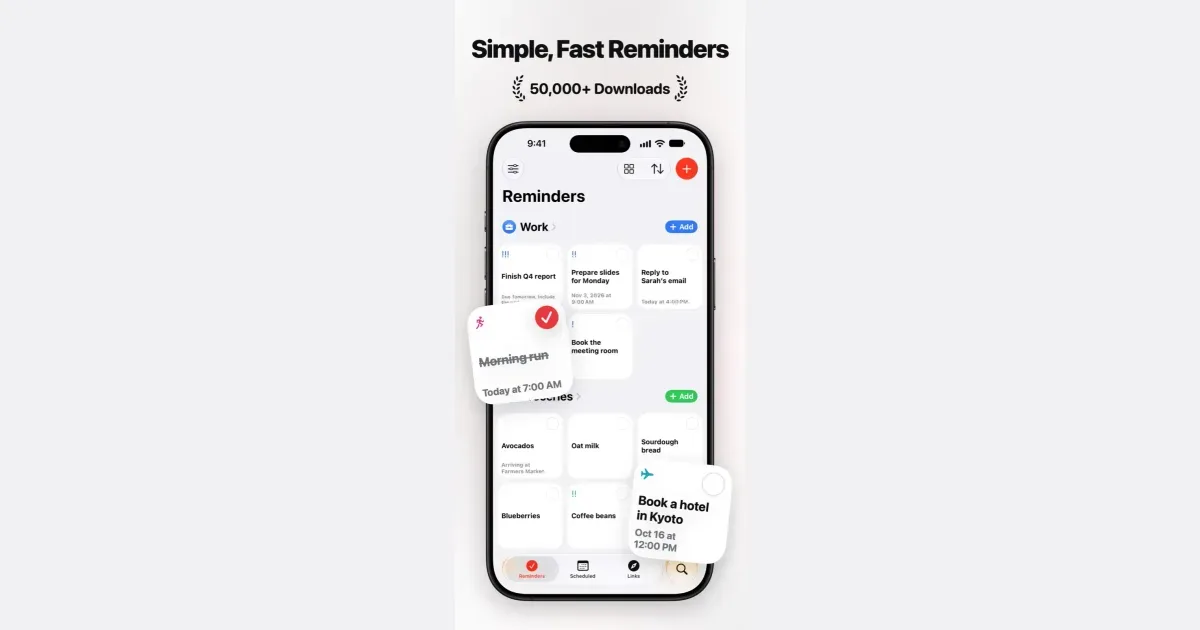
    Memento is a simple, fast reminders app for people who rely on their reminders. There's no clutter and no learning curve: it opens the reminders you already have in Apple's Reminders, synced through iCloud, and gives them a clean layout where every list has its own colour and icon and priorities stand out.

    Jot something down by typing naturally ("Call the plumber tomorrow at 9" sets the alert, list and priority as you write) or set time and location alerts so a reminder shows up at the right moment or place. Scheduled lays out everything coming up by day, week or month, and you can drag a reminder to another day to reschedule it.

    Choose from three layouts, Minimal, Peek and Expanded, with reminders as a list or as cards. Links keeps every web page you've saved to a reminder in one place, with previews, and Search finds any reminder by its title, notes, list or date, even with a typo. Actionable notifications, widgets, Siri and Shortcuts let you check things off without opening the app.

    Memento runs on iPhone, iPad, Mac, Apple Watch and Apple Vision Pro. It has no tracking and needs no account. It's a one-time purchase, made since 2016 by one independent developer.

    Who it’s for

    People who rely on their reminders and want them visible and quick to add, without the clutter or learning curve of a full planner. It uses the reminders you already have in Apple's Reminders.

    What makes it special

    Reminders as colour-coded cards on one screen, natural-language entry that sets the alert, list and priority as you type, and location alerts, all on top of Apple Reminders, so nothing to migrate.

    Approach to privacy

    No tracking and no account required. Optional anonymous crash reports, which you can turn off in Settings, never include your reminders. Reminders stay on your devices and sync through iCloud.

    Memento - Better Reminders screenshots

    Screenshot 1 of 6

    Key features

    • Type naturally

      "Call the plumber tomorrow at 9" sets the alert, list and priority as you write.

    • Time and location alerts

      Reminders go off at the right moment, or at the right place.

    • Scheduled view

      See what's coming up by day, week and month, and drag a reminder to another day to reschedule it.

    • Reminders as cards

      Three layouts (Minimal, Peek and Expanded), with reminders as a list or as cards.

    • Colour and icons for every list

      Each list gets its own colour and icon, and priorities stand out at a glance.

    Show all 12 features
    • Links

      Every web page saved to a reminder in one place, with previews.

    • Search

      Find any reminder by its title, notes, list or date, even with a typo.

    • Actionable notifications

      Get things done right from the notification, without opening the app.

    • Widgets, Siri and Shortcuts

      Widgets for your reminders, plus cards you can check off from Siri and Shortcuts.

    • Works with Apple Reminders

      Uses the reminders you already have in Apple's Reminders, synced through iCloud.

    • Every Apple device

      iPhone, iPad, Mac, Apple Watch and Apple Vision Pro.

    • Send reminders in Messages

      Share a reminder with a friend from the Messages app.

    Memento - Better Reminders pricing, explained

    Paid · US$7.99 one-time purchase

    Pricing has not been verified by our editors.

    Check current pricing on Memento - Better Reminders’s website

    App store ratings

    Memento - Better Reminders FAQ

    Do I have to move my reminders from Apple's Reminders?

    No. Memento opens the reminders you already have in Apple's Reminders and syncs them through iCloud, so everything stays in one place.

    Is it a subscription?

    No. Memento is a one-time purchase on the App Store (US$7.99 in the US; local prices vary).

    Which devices does it run on?

    iPhone, iPad, Mac, Apple Watch and Apple Vision Pro, synced through iCloud.

    Do I need an account?

    No account is required. Memento has no tracking.

    Can it remind me when I get somewhere?

    Yes. Reminders can go off at a time or when you get to a place.

    All Memento - Better Reminders tags

    Platforms

    iOSmacOSwatchOS

    Best for

    Daily RoutinesHousehold / ChoresWork / Professional

    Experience

    Low Setup FrictionMinimal / Low Stimulation UICustomizable Complexity

    Memento - Better Reminders alternatives

    Explore all Memento - Better Reminders alternatives →
    StickyCue: Lock Screen Cues logo

    StickyCue pins important tasks to your Lock Screen as a Live Activity card that stays until you finish, so reminders are harder to swipe away and forget.

    StickyCue is an anti-forgetting reminder app for iPhone and iPad, described as built for busy minds and anyone who struggles with standard reminders that get mindlessly swiped away. It pins a high-priority cue to your Lock Screen and Dynamic Island as a Live Activity card that stays until you actually finish the task. That helps when out-of-sight reminders disappear. Completing a cue takes a deliberate 1.5-second hold, so it is harder to dismiss by accident. Departure Shield can fire staged countdown alerts (for example 60 minutes, 15 minutes, and departure time), and optional repeating sound and haptic chimes can continue until you acknowledge them. The listing mentions everyday uses such as parking meters, flights, medication, time-sensitive bills or boiling water. Cue Renewal helps keep unfinished cues visible in Live Activities beyond the initial eight-hour period. StickyCue stores cues on your device and does not require an account.

    Helps with
    Apple
    Free; USD 2.99/month or USD 39.99 once
    View
    Routine logo

    All-in-one planner combining tasks, notes, and calendar

    Routine combines tasks, calendars, notes and project information in one workspace. Its planning view places work beside existing meetings, helping you decide when an action can happen instead of keeping a task list and a calendar mentally synchronized. The current product also offers AI assistance, meeting notes and automations for people who want to connect more of their work. A basic workflow starts with quick capture: use the desktop hotkey or another input route to record an action before switching away from the current task. Add context, organize the item with a project or label, and review it alongside your calendar. You can schedule work for a date or block a period for it, while multiple calendar layouts provide different views of the week. Support for several time zones helps when meetings cross locations. Notes and project information can stay close to the task they explain. Routine’s broader tools include meeting recording and summaries, voice input, integrations and customizable objects or databases. These features are optional directions for extending a planning system, not prerequisites for keeping a useful daily list. Calendar operations synchronize with connected accounts, so review the current supported services and permissions before connecting work calendars or recording meetings. Routine may suit someone whose main difficulty is moving between an inbox of commitments and a realistic view of their available time. Its flexibility also means there is room to spend more time designing the workspace than using it. Test one calendar connection and one project first. Confirm that capture and editing work comfortably on your devices, leave buffers between commitments, and revisit unfinished tasks deliberately. AI suggestions and automatic summaries should be checked before they become shared instructions or firm commitments.

    Helps with

    AppleWindowsMobile
    Free; $5–10/month (personal plans)
    View
    Airtable logo

    Visual database that works like a spreadsheet but thinks like a database

    Airtable is a configurable workspace for organizing structured information and turning it into useful workflows. Its tables hold records with different fields, so a project can track a status, date, attachment and related information together. It suits work that needs more context than a checklist but does not justify building a custom system from scratch. For example, a content team could keep each article as a record, connect it to a campaign and track who is responsible for the next step. Different views can make the same underlying information useful for different jobs, rather than requiring a separate spreadsheet for each person. Forms provide a way to collect information consistently, and automations can move routine work along after a defined event. Airtable's current platform also includes AI-assisted app building and agents. These expand what a workspace can do, but the foundation remains deciding what information belongs in the system and how people will use it. Before adding automated steps, establish clear field names and a simple process that can be understood by someone else. The main trade-off is setup and ongoing maintenance. A flexible base can become difficult to follow if every exception creates another field, view or automation. Start with one small workflow and a handful of essential properties, then test it with real examples. Airtable may fit project trackers, inventories and shared operational records particularly well. A simpler task app may be easier when all you need is a short list of next actions. Check current plan limits and collaboration arrangements before making it a team's central workspace.

    Helps with

    AppleWindowsMobile
    Free; from USD 20/user/month (billed annually)
    View
    Capacities logo

    Object-based notes that organize naturally for ADHD brains

    Capacities is a personal knowledge app that organizes notes around the things you think about: people, books, projects, meetings and ideas. Each item is an object with its own content and properties, connected to other objects through links. A daily note gives you somewhere to capture thoughts before deciding how much structure they need. For example, you could write meeting notes in your daily workspace, link the people involved, and connect the meeting to a project. The person's page then becomes a way back to related conversations, while the project brings together its supporting material. Backlinks and network views help you follow those relationships without maintaining a separate folder path for every note. Tags can cut across object types when several topics belong together. Custom object types let you decide which details matter. A book might have an author and reading status; a project might have dates, links and a completion status. Templates provide a repeatable starting point, and table, list, gallery and card views offer different ways to browse the same material. Capacities Pro also includes contextual task management, with tasks linked to objects and collected into an inbox, Today and scheduled views. Capacities may suit researchers, students and independent professionals who want connected reference material with a visual structure. Desktop, web and mobile apps support access across devices, although it is worth trying your actual capture and editing routine on each device. Start with a few useful object types and one real project: designing an elaborate taxonomy can create more decisions than it removes. If your main need is a short reminder list, test whether the knowledge-management layer adds enough value for you.

    Helps with

    BrowserAppleWindows
    Free and Paid Plans
    View

    Side by side